From data collection to action — DecisionFacts enables robots to sense, understand, reason, act, and learn.
Expert-demonstrated episodes, captured through teleop, for the exact tasks your robots need to learn.
Benchmark and fine-tune ACT, SmolVLA, GROOT, diffusion, and other policy architectures in sandbox before a single hour on real hardware.
Purpose-built field policies, deployed to edge compute and improved with every run.
Every dataset and policy we build is reasoning-ready — it includes data for scene grounding, subtask segmentation, motion-grounded spans, causal/contrastive notes (DPO), failure/recovery pairs, and derived VQA pairs.
Object identities and bounding boxes at episode start
Approach → grasp → align → insert → release
Language tied 1:1 to measured action
Why this action, not an alternative
Tied to the per-episode outcome label
Expert operators, production-grade teleoperation hardware, and your dataset format of choice — from pilot episodes to production-scale campaigns.
We choose the operator interface around task precision, throughput, and embodiment — not around a single favored tool.
Best for precision bimanual and contact-rich tasks with ALOHA-style manipulation.
Real robot vs. simulated policy, side by side — the same cup-nesting task from our sample dataset.
A handheld gripper with wrist-mounted cameras captures demonstrations with no robot in the loop — quick to scale across tasks, environments, and operators.
Dual wrist-camera views with tracked 3D trajectories from a real UMI episode — opening a bottle with the right gripper.
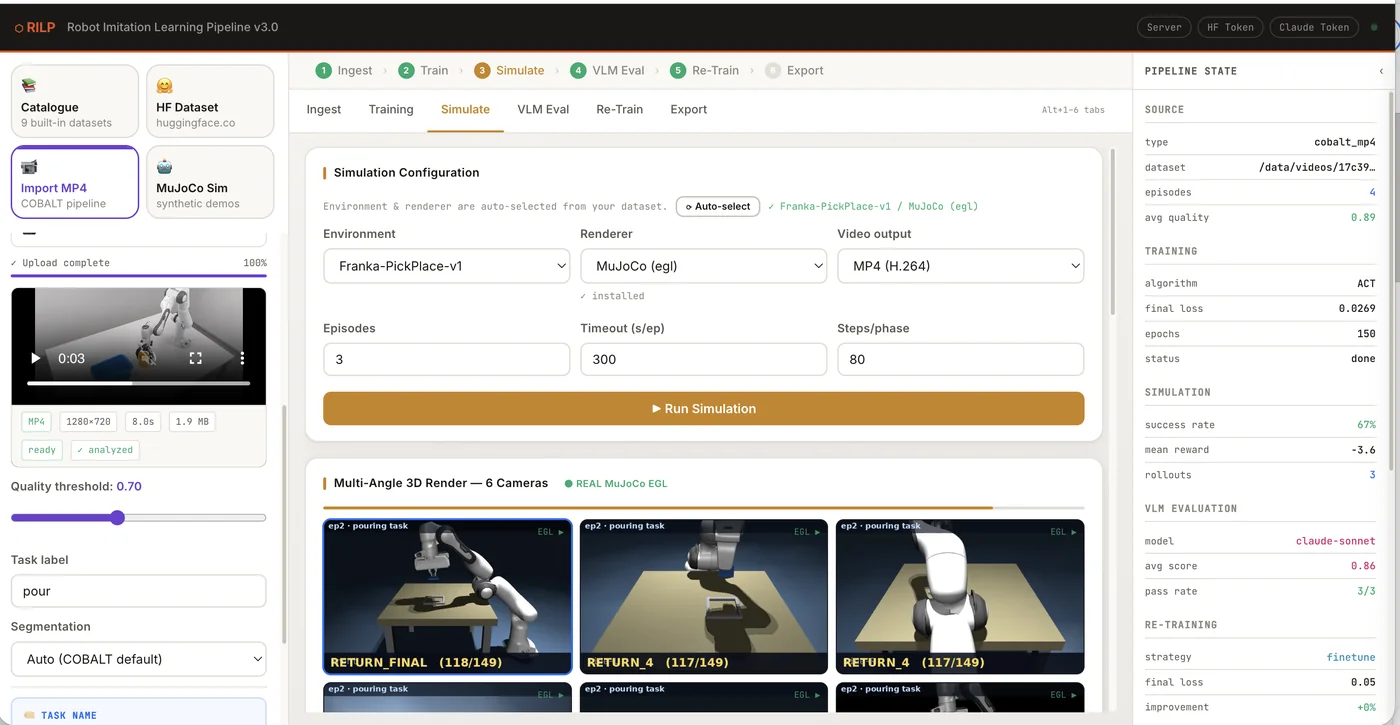
ACT, SmolVLA, and other VLA policies are trained, rendered across multiple camera angles in simulation, evaluated by a vision-language model, and re-trained — before a single hour on your real hardware.
Every move the arm makes is a decision from this trained policy — ACT and SmolVLA can learn directly from task episodes, while GROOT can be fine-tuned from a foundation model on top of them — validated in simulation before a single hour on real hardware.
The same kind of trained policy, running fully autonomously on real hardware — no leader arm, no human in the loop.
We check for:
All cameras, joints, and actions aligned to <5 ms tolerance using shared clock sources.
Identical observation/action schema, dimensions, data types, and key names.
Operators pass a proficiency test on the specific production task.
Every episode is reviewed; failures are flagged and separated on request.
Object positions, lighting, and workspace state follow documented reset ranges.
Camera streams are checked and episodes above the allowed loss rate are recollected.
Gripper signals are validated against visible contact and commanded actions.
Trajectories are checked for limit violations, clipping, and unsafe motion.
Robot, operator, task, calibration, scene, and timing metadata ship with every episode.
Labels follow a documented ontology with spot checks for consistency.
Proud member of the NVIDIA Inception Program
Whether you need demonstration data, simulation benchmarks, or a policy ready for the field — we'll be happy to assist you in your journey.
Contact us at info@decisionfacts.io